

AI & agentic commerce
Agentic Commerce in Airport Parking: From AI Booking to Barrier Access and Travel Services
By ParkingPro ·
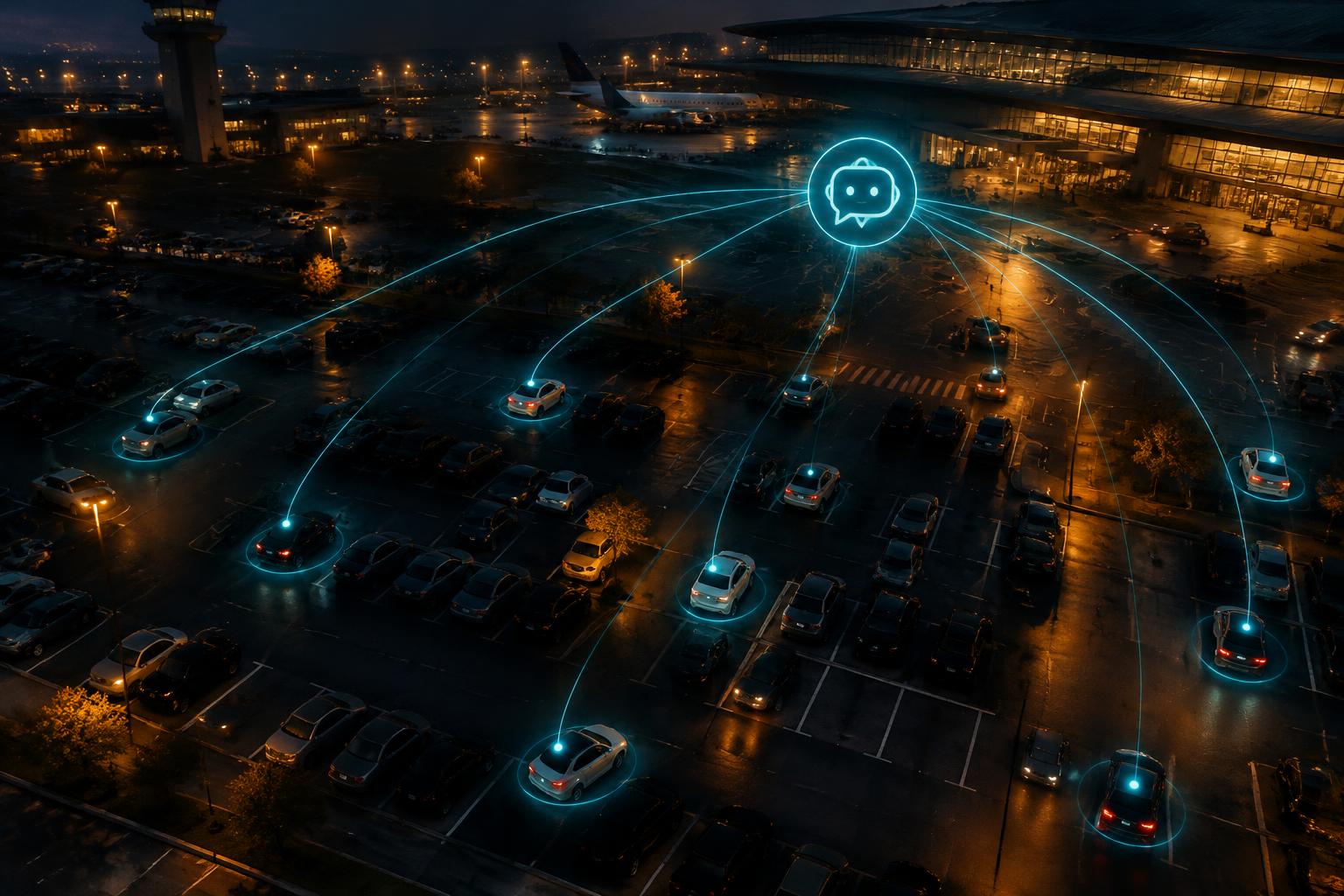
The future of airport parking extends far beyond an AI assistant simply searching for available spaces. Within the ParkingPro ecosystem, AI agents can directly query live parking rates and availability. The next evolution is a fully connected travel journey: from reservation and payment directly to the automatically opening barrier, complete with possibilities for ancillary travel services such as airport lounges, fast track security, taxis, and car rentals.
This emerging paradigm is known as agentic commerce.
AI agents are evolving from basic conversational bots into autonomous software agents capable of retrieving information, preparing bookings, and executing authorized commercial actions on behalf of users.
For airport parking operators, this unlocks significant new opportunities.
A traveler is not merely looking for a parking stall. They have an upcoming flight, may need to reach a specific terminal, want to save time at security checkpoints, and might require ground transportation at their final destination.
By interconnecting live reservation data, flight schedules, operational software, and partner integrations, an AI agent will soon be able to orchestrate a substantial portion of this entire journey.
ParkingPro provides the foundational layer for this reality: real-time parking data, booking software, API integrations, MCP capabilities, and deep connections into on-site parking operations.
- 250+
- parking facilities
- 100+
- API partners
- 5 mln+
- bookings processed
01What is agentic commerce in airport parking?
In traditional online booking, travelers navigate multiple websites independently.
First, they search for parking. Then they compare rates and offers, manually enter vehicle and personal details, and complete the transaction.
For any ancillary travel services, they typically must start the entire process over on third-party sites.
With agentic commerce, an AI agent can autonomously handle various stages of this workflow on behalf of the traveler.
For example, when a traveler prompts:
"I am flying out of Schiphol next week. Find me an eight-day parking space with shuttle service, check current rates, and help me secure the booking."
An AI agent can then, through authorized integrations and appropriate permissions, retrieve the relevant operational data and execute supported actions.
The defining difference from a conventional chatbot is that an agent does not rely solely on pre-indexed web text.
It interfaces directly with operational software where live inventory and pricing data reside.
From information to execution
An agentic parking workflow may encompass several distinct stages:
1. Identifying suitable parking products. 2. Verifying real-time availability and dynamic pricing. 3. Retrieving applicable booking terms and cancellation policies. 4. Preparing the reservation payload. 5. Submitting the reservation upon explicit user authorization. 6. Processing a supported payment flow. 7. Connecting the confirmed booking directly to on-site parking operations. 8. Presenting contextually relevant ancillary travel services.
Not every AI implementation immediately supports all of these stages; doing so requires deep integrations, strict permission boundaries, and robust transaction capabilities.
However, this progression highlights why centrally managed parking data is rapidly becoming mission-critical.
02AI agents can query real-time parking availability directly via ParkingPro
Access to authoritative real-time information is the bedrock of agentic commerce.
Airport parking rates fluctuate based on seasonality, length of stay, real-time occupancy, commercial rules, and sales channels.
Similarly, lot availability shifts continuously due to incoming bookings, cancellations, and capacity blockouts.
Static price lists or cached availability feeds are inadequate for transactional automation.
Through ParkingPro's native API and MCP infrastructure, authorized AI agents can directly verify live rates and capacity across parking products managed within ParkingPro.
This empowers an AI agent to execute precise queries based on parameters including:
Airport facility and parking lot location. Arrival date and entry time. Departure date and exit time. Requested parking tier or service level. Live inventory capacity. Applicable tariffs, yield rules, and commercial terms.
ParkingPro processes these requests in real time according to the operator's current operational rules.
The AI agent can then present the traveler with accurate, bookable options.
Why direct verification is essential
An AI agent relying on scraped or cached web pages cannot guarantee that a parking stall remains available.
By interfacing directly with ParkingPro, the agent works with verified operational data necessary for a reliable booking transaction.
The AI agent manages the digital interaction. ParkingPro powers the live operational parking data.
This distinction marks the fundamental difference between generic conversational search results and actionable software-driven execution.
The AI agent manages the digital interaction. ParkingPro powers the live operational parking data.
03MCP and APIs connect AI to the ParkingPro ecosystem
ParkingPro operates an international network of API integrations connecting booking channels, aggregators, and operational technologies.
This infrastructure already facilitates the seamless exchange of reservation details, pricing structures, and inventory across systems.
In addition, ParkingPro natively incorporates MCP functionality across its software platform.
MCP stands for Model Context Protocol, an open standard that allows compatible AI models and agents to interact with external business applications in a secure, structured manner.
Within ParkingPro, authorized AI agents can query live operational data using standardized interfaces.
The scope of actions an agent can perform is strictly governed by granular access control and integration rules.
This architectural separation is vital.
An AI agent authorized to check lot capacity does not automatically possess rights to modify a reservation, issue a cancellation, or initiate a payment.
Every operational step requires explicit permissions and validation.
In this way, ParkingPro bridges operational parking data with both established distribution channels and emerging AI-driven interfaces.
04From agentic search to a confirmed parking reservation
Surfacing a live price and an open space is only the starting point of an agentic transaction.
Converting that query into a confirmed booking demands rigorous operational verification.
Consider an AI agent that identifies a parking option matching the traveler's exact specifications.
The agent presents the facility details, total price, and booking conditions.
Once the traveler approves, an agentic integration can initiate the following progression:
Live re-verification
Is the requested inventory still available at the precise moment of booking?
Final rate lock
What is the verified final rate and applicable terms for the requested duration?
User authorization
Has the traveler explicitly confirmed the purchase intent and terms?
Order execution
Can the central management platform ingest and commit the reservation?
Confirmation delivery
Has the booking been successfully written to the operational database?
ParkingPro provides the established Booking Engine and API infrastructure required to process and record these reservations securely.
A full agentic booking journey requires an authorized AI interface capable of completing this sequence.
A reservation is only treated as valid once operational confirmation has been formally issued by the core system.
05Agentic upselling: from parking booking to a complete travel journey
The potential of agentic commerce reaches far beyond reserving a parking space.
An airport parking reservation provides rich context about an upcoming trip.
It establishes departure dates, return timelines, terminal locations, projected arrival times, and—where permitted—flight numbers.
This contextual awareness allows an AI agent to suggest complementary services that genuinely enhance the traveler's specific trip.
This is known as contextual upselling or agentic upselling.
Rather than serving generic banner ads, the AI agent can curate relevant travel products tailored to the traveler's schedule and travel profile.
Airport lounges
A passenger arriving at the airport well before boarding can benefit from airport lounge access.
With appropriate partner integrations in place, an AI agent can check lounge capacity and package availability.
For example:
"You are scheduled to arrive 2.5 hours prior to boarding. Would you like to view available lounge passes for your departure terminal?"
Fast track and priority security
For business travelers or passengers flying during peak hours, expedited security screening offers clear value.
An AI agent can introduce this option if the departure airport and terminal support fast track access.
Live availability and ticketing conditions must be verified via the relevant service provider.
Taxis and airport transfers
Not every traveler intends to rent a vehicle upon landing.
Many prefer a pre-booked airport transfer or taxi awaiting their arrival.
Utilizing destination details and arrival times, an AI agent can propose suitable ground transportation options.
Should flight delays occur, synchronized flight tracking helps adjust the pickup schedule dynamically.
Car rentals
Travelers embarking on multi-day itineraries at their destination may require a rental vehicle.
An AI agent can prompt proactively:
"Would you like to reserve a rental car at your destination for the duration of your stay?"
Through a dedicated car rental integration, the agent can compare categories, rental terms, and live rates.
This seamlessly ties vehicle rental into the broader digital travel booking flow.
Ancillary parking services
Operators can also maximize revenue on-site by offering operational add-ons.
Options include:
Upgrades from shuttle parking to valet parking. Covered or indoor parking allocations. Electric vehicle (EV) charging packages. Vehicle detailing, car washing, or maintenance services. Other custom ancillary services offered by the facility.
These upgrades can be aligned with the traveler's arrival schedule and vehicle specifications.
The core principle is that the AI agent does not simply push inventory; it curates contextually relevant additions for the traveler.
The fulfillment of lounge access, fast track passes, transfers, car rentals, and other third-party products requires active integrations with those specialized providers. These ancillary offerings do not all need to reside natively within ParkingPro today.
06Flight data as the engine for contextual travel offers
Real-time flight details are pivotal for high-conversion agentic upselling.
When a passenger links their flight data and the platform connects to flight tracking systems, deep operational context emerges.
Consider the following scenarios:
Departure airport
Determines which parking locations, lounges, and security lanes are physically accessible.
Departure time
Calculates ideal facility arrival windows and highlights available dwell time for lounge visits.
Destination airport
Triggers relevant ground transportation, transfer, or car rental recommendations.
Arrival time
Coordinates rental car pickup schedules or private driver meet-and-greet timings.
Inbound flight delays
Automatically alerts parking operations to adjust valet returns and shuttle dispatch schedules.
ParkingPro features native capabilities to incorporate flight data into day-to-day operations.
For shuttle and valet operations, flight tracking ensures ground teams are prepared for shifts in arrival and return times.
In agentic commerce, this same intelligence enables the agent to trigger upsell suggestions at the precise moment they provide utility.
A connected journey scenario
A traveler interacts with an AI agent to secure parking at Schiphol.
The AI agent checks rates and availability directly against ParkingPro.
Once the reservation is confirmed, the agent—operating with user permission—identifies a two-hour pre-flight window and suggests lounge access.
It concurrently offers a rental vehicle ready upon arrival at the destination airport.
The traveler reviews and selects the preferred options.
Through connected partner APIs, these ancillary products are booked within a unified agentic session.
A standalone parking transaction thus transforms into the foundation of a coordinated, multimodal travel itinerary.
07Payments, split transactions, and ancillary bookings
When an AI agent orchestrates parking alongside multiple travel components, financial clearing and accounting precision become critical.
A parking reservation, an airport lounge pass, and a rental car may involve entirely different merchants of record and legal terms.
Clear boundaries must be established for:
What exact product or service the traveler is purchasing. Which legal entity is fulfilling each component. The verified, itemized pricing breakdown. The governing cancellation, refund, and payment terms. Formal issuance of booking confirmations across all parties. How amendments, extensions, and cancellations are resolved. How automated refunds are routed.
While an AI agent can initiate or orchestrate a multi-party checkout, each underlying transaction must be validated and acknowledged by the respective operational platform.
Within the ParkingPro ecosystem, core reservation data links seamlessly with supported payment workflows.
Expanding this into full agentic payment flows and third-party travel products requires dedicated commercial and technical integrations.
The operational mandate remains clear:
Every service presented to the user must be genuinely available, accurately priced, and reliably fulfilled.
08From AI booking to physical on-site parking operations
Agentic commerce reimagines how bookings originate.
Yet the physical parking operation remains as vital as ever.
When the vehicle arrives on-site, ground personnel and physical infrastructure must know which vehicle is arriving, at what time, and what services have been booked.
ParkingPro underpins these operational workflows through:
Centralized reservation management. Live arrival and departure operational dashboards. Shuttle and valet management modules. The ParkingPro Driver App. Digital vehicle damage recording. Real-time flight tracking feeds. ANPR (Automated Number Plate Recognition) and QR access control. Direct barrier gate and hardware integration.
Consequently, a booking generated via an AI agent enters the exact same operational ecosystem as a booking made via your own website or an OTA partner.
This consistency is crucial: parking operators do not need distinct operational workflows for each emerging digital sales channel.
09From confirmed booking to automated barrier access
Automated vehicle access based on a valid reservation represents one of the most practical examples of an interconnected parking ecosystem.
Consider a traveler who books parking via an AI agent.
The transaction is committed to the ParkingPro database.
The vehicle registration plate and reservation credentials immediately synchronize with the integrated access control layer.
Upon arrival at the facility, an ANPR camera captures the license plate.
The access control system cross-references the credentials against live business rules and validity windows.
If the booking is confirmed and valid, the barrier gate actuates automatically.
The AI agent does not trigger the physical hardware directly.
Access decisions remain strictly governed by the local and operational systems responsible for physical security and hardware control.
QR credentials and other supported digital passes operate on the exact same architecture.
The passenger journey begins with a natural-language AI prompt and concludes with physical entry at your facility—connected seamlessly through ParkingPro.
10A unified ecosystem across parking and travel services
The roadmap toward agentic commerce unfolds across distinct, synchronized milestones:
Step 1 — AI travel prompt
The traveler specifies their departure airport, travel window, and preferred parking category.
Step 2 — Real-time ParkingPro query
The AI agent queries ParkingPro directly to inspect live inventory, dynamic tariffs, and booking conditions.
Step 3 — Reservation preparation
The agent structures the reservation payload and, following traveler confirmation, submits the booking via an authorized integration.
Step 4 — Operational confirmation
The reservation is committed to the central ParkingPro operational database.
Step 5 — Agentic upselling
Using available flight and trip parameters, the agent surfaces relevant ancillaries such as lounge access, fast track, vehicle hire, or on-site detailing.
Step 6 — Ancillary fulfillment
Upon user approval, integrated partner systems verify availability, calculate pricing, and issue secondary reservations.
Step 7 — On-site operational dispatch
The parking facility's operational roster reflects the incoming booking, preparing shuttle or valet resources accordingly.
Step 8 — Access verification
Upon arrival at the facility, an integrated ANPR camera or QR scanner reads the entry credentials.
Step 9 — Automated barrier actuation
Once credentials are authenticated against the reservation rules, the barrier gate opens automatically.
ParkingPro's core capabilities in real-time inventory management, booking workflows, and access control integrations provide the essential platform for this evolution. Full end-to-end agentic travel journeys involving third-party travel products depend on the deployment of specific partner integrations.
From AI search to barrier gate access. From parking spaces to connected travel services. Powered by the ParkingPro ecosystem.
11What this means for commercial parking operators
For airport parking operators, the emergence of agentic commerce introduces two transformative strategic shifts.
First, it introduces a completely new, direct acquisition channel for parking inventory.
Travelers using AI agents can locate parking facilities and verify live availability through conversational software.
Second, it creates a mechanism to package complementary travel services alongside the base parking space.
Rather than serving solely as a car park, the operator—supported by partner integrations and commercial agreements—becomes integral to a broader, automated travel workflow.
This does not require parking operators to manage lounge operations, fleets of rental vehicles, or taxi dispatch internally.
The strategic role of integrated software is precisely to allow disparate providers to interface through standardized protocols.
For operators, the operational foundation remains unchanged: accurate live data, reliable business logic, and flawless on-site fulfillment.
For travelers, it delivers a frictionless, highly coordinated booking journey.
12Why an integrated operational platform remains essential
ParkingPro powers an international network of commercial parking operators and industry technology partners.
Managing over 250 parking facilities, collaborating with 100+ API partners, and having processed more than 5 million bookings, the platform provides the hardened infrastructure required for digital parking distribution and management.
The shift toward agentic commerce amplifies the value of this proven foundation.
An AI agent requires deterministic, real-time data.
A booking command must be captured without data conflicts.
Financial payments must reconcile precisely with booked services.
Ancillary products must be fulfilled by authorized suppliers.
And when the customer arrives on-site, physical parking operations must execute the service seamlessly.
Agentic commerce is not just about intelligent conversational interfaces.
It is about the dependable bridge connecting digital interaction, financial authorization, and physical service delivery.
This is where an integrated parking management platform proves indispensable.
The future of airport parking goes beyond the parking space
Agentic commerce is fundamentally altering more than how travelers search for parking.
It is reshaping how disparate travel services are discovered, bundled, and booked within a single fluid process.
An AI agent can query ParkingPro directly for real-time rates and live availability.
A confirmed booking integrates instantly into daily on-site operational workflows.
And with the appropriate integrations in place, value-added services such as airport lounges, priority security, taxis, and car rentals can be matched to the traveler's itinerary.
Upon arrival, on-site operations execute the booking through ANPR camera systems and automated barrier actuation.
This outlines an operational model where digital booking and physical execution are completely aligned.
From Agentic Booking to Barrier Access. From Parking to Travel Services. One connected ParkingPro ecosystem.
ParkingPro — The Real-Time Platform Behind International Parking Bookings.
Frequently Asked Questions about Agentic Commerce and ParkingPro
What is agentic commerce in airport parking?
Agentic commerce refers to autonomous AI agents retrieving operational data and, with proper integrations and permissions, preparing or executing reservations and related commercial transactions on behalf of travelers.
Can an AI agent directly check parking availability?
Yes. Through ParkingPro's existing API and MCP infrastructure, authorized AI agents can directly verify live capacity and rates for parking products managed within the ParkingPro platform.
Accessible data and allowed actions depend on the specific integration parameters and granted authorization scopes.
Can an AI agent complete a parking reservation autonomously?
ParkingPro supports end-to-end booking processing via its established Booking Engine and API integrations. For an AI agent to execute a reservation autonomously, it must connect through a dedicated, authorized booking integration.
Can an AI agent offer ancillary travel products?
Yes. Agentic commerce enables contextual upselling based on trip parameters, including airport lounges, fast track passes, taxis, rental cars, and premium parking add-ons. Live availability and booking fulfillment depend on active partner integrations.
What role does flight data play in agentic upselling?
Connected flight data provides critical context to identify relevant services, such as departure terminal lounges, priority security, or rental vehicles upon arrival. Utilizing this data requires appropriate user consent and verified data integrations.
Does ParkingPro support shuttle and valet parking operations?
Yes. ParkingPro provides complete reservation management and operational applications tailored specifically for shuttle parking, valet services, and commercial airport parking facilities.
Can an AI agent open the barrier gate directly?
The AI agent does not trigger the barrier gate directly. In an integrated setup, the confirmed reservation synchronizes with the on-site access control system. When entry conditions are met, the integrated barrier gate actuates automatically.
Is the complete agentic workflow available out of the box today?
Direct queries for live rates and availability, robust booking software, and access control integrations are active capabilities within ParkingPro. Fully autonomous agentic purchasing including multi-party travel ancillaries requires dedicated end-to-end integration and commercial authorization.