

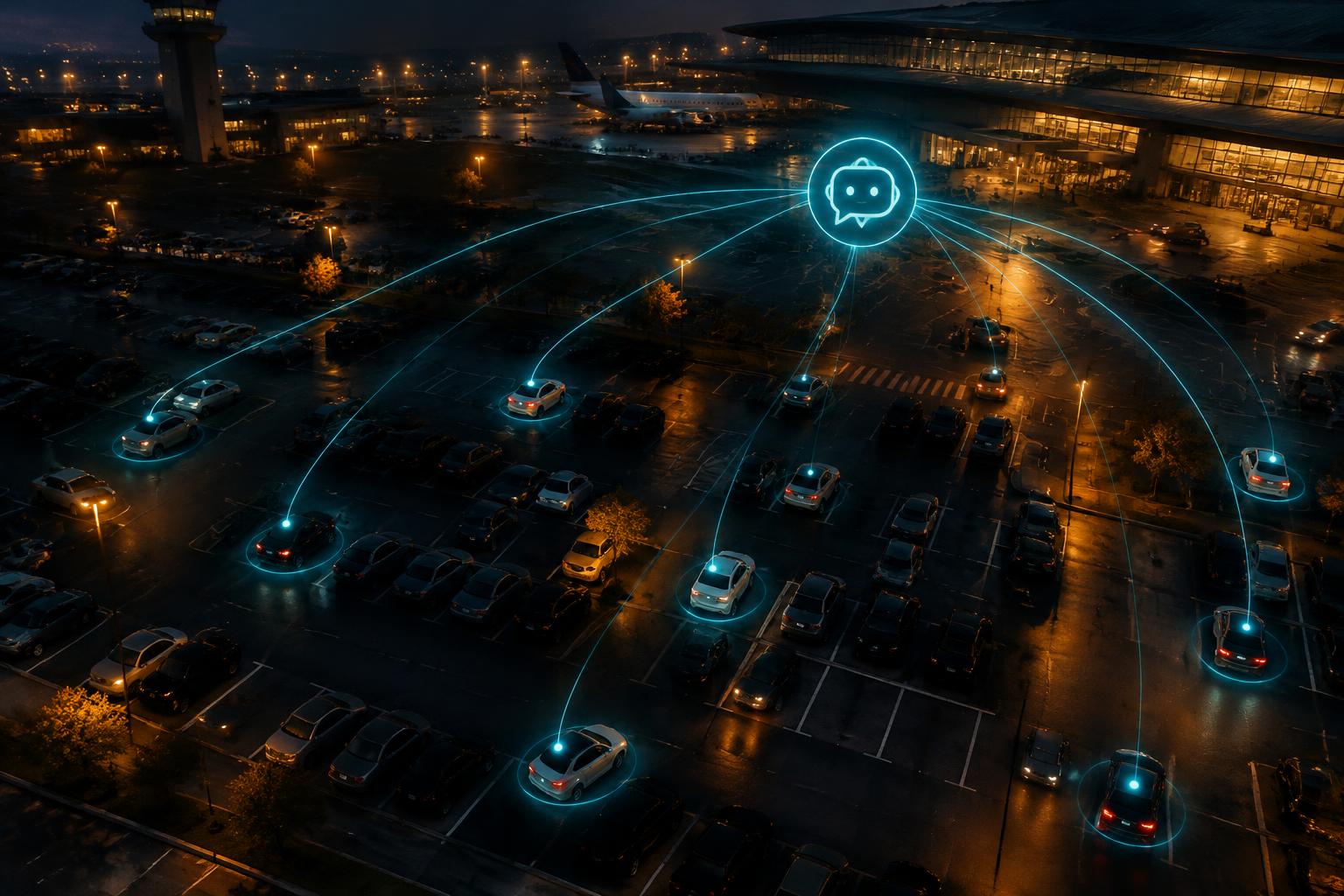
AI & agentic commerce
ParkingPro & ACP: The Future of Agentic Parking Commerce — From AI Booking to Barrier Access
By ParkingPro ·
The next generation of airport parking bookings does not necessarily start on a website. A traveler can communicate their parking requirements directly to an AI agent, have live prices and availability verified, and complete a reservation via a dedicated checkout integration.
With the Agentic Commerce Protocol (ACP), a new standard is emerging for executing commercial transactions between AI agents and providers.
For the airport parking industry, this unlocks compelling opportunities.
An AI agent can discover a parking space.
ParkingPro can deliver real-time parking rates and availability.
A dedicated commerce integration can handle the reservation and payment steps.
And the confirmed booking can then connect seamlessly with the physical parking operation.
From digital request to automated license plate recognition.
From reservation to barrier access.
From AI Discovery to Barrier Access. One Connected ParkingPro Ecosystem.
- 250+
- parking locations
- 100+
- API partners
- 5 mln+
- processed reservations
01What is agentic commerce?
Traditional online booking requires a traveler to manually visit a website, enter a parking duration, and navigate the reservation process.
In agentic commerce, an AI agent can execute various stages of this process on the traveler's behalf.
The traveler communicates their requirements in natural language.
For example:
"I am flying out of Amsterdam Airport Schiphol next month. Find me a parking space for ten days, including a shuttle to the terminal. Check the live rate and help me book."
Through compatible integrations, the AI agent can subsequently: - Identify suitable parking products. - Verify real-time availability. - Retrieve live total prices. - Present the applicable terms and conditions. - Prepare a checkout session. - Execute an authorized transaction upon approval. - Return the confirmed reservation details to the user.
This represents far more than just a new user interface.
It is a fundamental evolution in how digital systems interoperate.
The traveler interacts with an AI agent. The operational software processes the actual reservation.
02Why real-time parking data is essential
An airport parking space is not a static product with fixed pricing and unlimited inventory.
Live bookability depends on multiple variables.
These include: - Arrival date and departure time. - Total duration of stay. - Selected parking facility. - Type of parking service. - Live booking capacity. - Seasonal pricing and dynamic yield tariffs. - Operating hours and blacked-out periods. - Channel-specific commercial conditions.
An AI agent relying solely on previously indexed parking rates cannot guarantee that a space remains available.
To ensure availability, it must query live data directly from the authoritative operational system.
ParkingPro provides real-time operational data
Through ParkingPro's existing API and MCP capabilities, authorized AI agents can directly verify live parking rates and availability for parking products managed within ParkingPro.
This enables an AI agent to utilize data that reflects the current tariff rules, capacity thresholds, and reservation settings.
This provides an essential foundation for agentic commerce.
The AI agent does not have to calculate available space independently.
It requests the accurate figures directly from the platform where the parking operator manages its daily operations.
Reliable AI Bookings Start with Real-Time Operational Data.
MCP for Connectivity. ACP for Commerce. ParkingPro for Operations.
03What is the Agentic Commerce Protocol (ACP)?
The Agentic Commerce Protocol, abbreviated as ACP, is an open standard outlining how AI agents and merchants can execute commercial transactions across standardized interfaces.
With ACP, an AI agent does not need to emulate every manual click on a traditional booking website.
Instead, it interacts with an automated checkout integration designed specifically for this purpose.
The official specification governs the creation, retrieval, updating, completion, and cancellation of checkout sessions.
The protocol also defines the communication standards between the participating parties and the capabilities they support.
What does this mean for airport parking?
A parking reservation involves specific operational attributes that must be processed accurately throughout the checkout flow.
A parking product is valid only for a defined timeframe.
Available capacity fluctuates continuously.
The total price depends on configured rate structures and business rules.
And upon successful confirmation, the reservation must be instantly accessible to the parking operator.
An ACP-compatible booking flow must therefore operate in sync with the operational booking infrastructure.
ACP defines the commercial checkout. ParkingPro provides the operational engine for rates, availability, and reservation management across connected parking products.
04MCP and ACP: two distinct roles, one unified future
MCP and ACP are often discussed together, but they serve distinct functions.
MCP — connecting AI to software
MCP stands for Model Context Protocol.
It enables compatible AI applications to interface in a standardized manner with external software and the specific tools exposed by that system.
ParkingPro features native MCP functionality.
Through supported, authenticated connections, AI agents can query live parking rates and availability.
ACP — standardized agentic checkout
ACP focuses on the commercial transaction.
This encompasses managing checkout sessions, recording selections, and completing transactions via an appropriate payment integration.
The merchant remains responsible for pricing accuracy, product availability, order fulfillment, and service delivery.
How MCP and ACP complement each other
An AI agent can query real-time parking data via a compatible ParkingPro integration.
Subsequently, a dedicated ACP-compatible checkout can facilitate the reservation and payment workflow.
Once successfully processed, the user receives an official booking confirmation.
MCP for Connectivity. ACP for Commerce. ParkingPro for Operations.
It is important to note that MCP connectivity alone does not mean a full ACP checkout is automatically active.
A complete implementation requires the integration of dedicated checkout interfaces, payment gateways, authorization logic, and transaction status handlers.
05ParkingPro: ACP-Ready by Design
ParkingPro already features core technical components required for future agentic commerce workflows.
Real-Time Availability
Live availability checks based on configured parking capacity, active reservations, and booking constraints.
Dynamic Pricing
Automated rate calculation tailored to the requested stay duration, parking product, and applicable commercial settings.
Booking Engine
A robust foundation that allows supported external platforms to submit and process reservations.
API Integrations
Seamless connections between ParkingPro and third-party booking and distribution systems.
MCP Connectivity
Enables authorized AI agents to directly retrieve real-time operational parking data.
Operational Fulfilment
A confirmed booking integrates instantly into daily parking operations, including arrival and departure logistics.
Access Control
Integration capabilities for compatible ANPR cameras, barrier gates, QR code scanners, and access management hardware.
These capabilities position ParkingPro as technically prepared for the ongoing evolution of agentic commerce.
ACP-Ready by Design indicates that the platform provides the necessary operational architecture upon which a standardized ACP checkout flow can be deployed.
It does not imply that an out-of-the-box, certified ACP implementation is currently active.
06From AI search query to confirmed parking reservation
Imagine a traveler wishing to book airport parking through an AI agent.
What could this workflow look like in an ACP-compatible setup?
Step 1 — The traveler states their requirements
The user provides the destination airport, arrival and departure timestamps, and preferred parking tier.
Step 2 — The AI agent verifies availability
Using a supported integration, the agent queries live data from ParkingPro.
Step 3 — ParkingPro returns the operational data
The platform validates applicable rates, remaining capacity, and booking rules.
Step 4 — The user selects the parking product
The agent presents the available option along with the accurate total rate and terms.
Step 5 — The checkout session is prepared
An ACP-compatible integration creates a checkout session for the chosen service.
Step 6 — The transaction is authorized
The user confirms their consent for the reservation and payment.
Step 7 — The reservation is confirmed
The connected systems complete the transaction, and the booking is confirmed only once operational processing has succeeded.
Step 8 — The traveler receives their confirmation
The definitive booking details are delivered back to the user.
This represents an architectural blueprint of an agentic checkout flow, not a guarantee that every stage is active by default via ACP in ParkingPro today.
The AI Agent Handles the Conversation. ParkingPro Handles the Parking Reservation.
07A parking booking is only complete when the facility is prepared
An airport parking reservation is more than a digital transaction.
The traveler must physically arrive at the facility and access the reserved service without friction.
For shuttle parking, staff require visibility over scheduled arrival times and return flights.
For valet parking, vehicle inspection, key storage, and handover logistics are mandatory.
For automated parking facilities, the access control system must instantly determine whether an arriving vehicle holds a valid booking.
ParkingPro connects digital bookings directly with operational software and physical hardware integrations.
As a result, reservations generated via AI agents do not require separate, isolated operational handling.
Once confirmed via an authorized integration, they enter the same central management environment as bookings from direct websites or third-party resellers.
Agentic commerce transforms the digital booking channel. The operational parking execution remains anchored in ParkingPro.
08From Agentic Booking to Barrier Access
One of the most practical applications of this evolution is connecting an AI booking directly to automated parking access.
A traveler reserves a parking space using a compatible AI and checkout integration.
The booking is recorded in the operational software.
The vehicle license plate or access credential is made accessible to the connected access control system.
Upon arrival, the vehicle pulls up to the entrance barrier.
An ANPR camera scans the license plate.
The access system checks whether the reservation and access rights are valid.
When validated, the barrier opens automatically.
The AI agent does not trigger the barrier directly
This distinction is critical.
An AI agent should never possess unchecked control over physical infrastructure.
The robust, secure approach ensures the reservation is formally validated first, allowing the local access control system to decide whether entry is granted.
This keeps physical security firmly embedded within the parking operator's operational protocols.
AI Discovery → Live Availability → ACP Checkout → Confirmed Booking → ANPR → Barrier Access
From Agentic Commerce to Physical Access. Powered by ParkingPro.
09Pre-booked and on-demand parking
Agentic commerce is not limited to parking spaces reserved days or weeks in advance.
On-demand parking scenarios also stand to benefit.
Pre-booked parking
A traveler books ahead using their preferred digital assistant.
Upon arrival, the verified reservation is already synchronized with local access control systems.
On-demand parking
A driver arrives without an existing reservation.
Through a mobile interface or supported conversational AI, they can query real-time products and rates.
If the facility supports it, an on-the-spot booking and payment process can be initiated.
Once completed, access authorization is provisioned immediately.
This model fits naturally into ticketless parking environments.
The specific capabilities depend on local hardware, supported payment methods, and the integration setup.
Pre-booked or On-Demand. One Connected Parking Ecosystem.
10Agentic upselling: parking reservations as part of the complete journey
The capabilities of agentic commerce reach far beyond a standalone parking transaction.
An airport parking booking contains valuable contextual data about the customer's travel plans.
This includes travel dates, departure and arrival airports, and, where provided and authorized, flight numbers.
An AI agent can leverage this context to suggest relevant ancillary services.
For example:
Airport Lounge Access
A traveler arriving well ahead of departure may appreciate a lounge recommendation.
Fast Track
Where the airport offers priority security lanes, an AI agent can present fast-track booking options.
Taxi & Airport Transfers
Based on destination airport and landing schedules, local transfers can be proposed.
Car Rental
A traveler may require vehicle rental upon arrival at their destination.
Parking Upgrades
Upgrades from standard open-air parking to valet parking, covered parking, or premium bays.
Vehicle Services
EV charging, exterior washing, or interior detailing provided by the parking operator.
Contextual Commerce over generic promotions
A relevant offer aligns naturally with the passenger's itinerary.
A traveler who has already secured a rental car should not be prompted with another vehicle offer.
A passenger on a tight schedule benefits more from operational terminal directions than additional promotional offers.
The goal of agentic upselling is not product saturation.
The objective is surfacing the right services precisely when the customer needs them.
Enabling live bookings for airport lounges, fast track, transfers, rental cars, or external services requires separate partner integrations and commercial agreements.
These services are not active by default within ParkingPro.
Parking Is the Starting Point. Connected Travel Commerce Is the Opportunity.
11What does ACP mean for airport hotels?
Agentic commerce presents notable opportunities for airport hotels.
A traveler might ask:
"Find a hotel near Amsterdam Airport Schiphol where I can stay for one night and leave my car parked for ten days during my vacation."
This is not a conventional room-only booking.
It is a combined package involving hotel accommodation and long-stay parking.
Room availability must be validated via the hotel reservation system.
Parking availability must be verified for the entire vehicle stay.
And combined package tariffs must be calculated accurately.
ParkingPro supports standalone parking inventory management for airport hotels, including centralized rate and capacity controls.
Within an agentic travel flow, these parking products can be bundled with lodging, provided the respective platforms are integrated.
One physical parking facility, multiple commercial models
An airport hotel can allocate capacity across: - Overnight hotel guests. - Park, Sleep & Fly packages. - Direct public parking reservations. - Third-party parking aggregators. - Walk-up on-demand parking.
Agentic commerce must follow the same operational rules as traditional sales channels.
Reservations from emerging AI platforms must never inadvertently exceed allocated capacity or compromise existing commitments.
New Booking Channels. Same Operational Control.
12Who maintains control over the reservation and the customer?
A fundamental principle of agentic commerce is that a new conversational interface does not assume full operational ownership of a transaction.
The parking operator remains responsible for fulfilling the parking service.
Valid tariffs, policies, and capacity quotas originate directly from the authoritative operational platforms.
A checkout flow must clearly display the legal merchant, applicable price, and terms accepted by the user.
The commercial structure can vary depending on whether an aggregator or intermediary facilitates the sale.
Technical integrations and contractual agreements must reflect the underlying distribution model.
ParkingPro manages the operational processing of bookings for connected parking products.
An ACP integration must seamlessly align with these core operational workflows.
AI Can Transform the Booking Experience Without Taking Control Away from the Parking Operator.
13Security, consent, and reliable transaction processing
When AI agents carry out commercial actions, clear security boundaries are vital.
An agent must not be permitted to execute every technically possible action without oversight.
A clear distinction must exist between retrieving information, preparing a checkout session, confirming a booking, and executing payment.
Systems must also handle technical edge cases gracefully.
For instance, network interruptions might trigger automated retry requests.
A robust booking integration must prevent retries from resulting in duplicate reservations or unauthorized charges.
Core architectural principles
Authorization
The AI agent is strictly limited to authorized workflows.
Real-time validation
Rates and inventory are re-validated immediately before the reservation is finalized.
Accurate transaction states
A pending checkout is never mischaracterized as a confirmed booking.
Idempotency & error handling
Duplicate calls and communication drops are handled safely without data corruption.
Payment security
Payment credentials are processed exclusively via compliant, dedicated payment infrastructure.
Operational control
The parking operator retains complete authority over parking products, capacity thresholds, and facility access rules.
These principles are fundamental when engineering agentic commerce integrations.
14ParkingPro: prepared for the next generation of digital distribution
ParkingPro powers an international network of professional parking operators and integrated technologies.
With over 250 parking locations, more than 100 API partners, and over 5 million processed bookings, ParkingPro offers a mature infrastructure for managing rates, capacity, reservations, and day-to-day operations.
This infrastructure plays an essential role in new digital distribution channels.
While traditional distribution relies primarily on web portals and aggregator platforms, AI agents introduce an additional channel for travelers to discover and book parking.
MCP facilitates authorized contextual access to operational data.
ACP establishes a standardized protocol for automated commercial checkouts.
ParkingPro provides the operational foundation and booking engine that these technologies require.
ACP-Ready by Design. Powered by Real-Time Parking Data.
The deployment of a live, end-to-end ACP checkout depends on ongoing technical integrations, payment connectivity, and validation testing.
The Future of Parking Commerce Is Connected
The next chapter of airport parking commerce is about much more than locating an available space.
It revolves around end-to-end connectivity between the passenger, the AI agent, live operational data, the booking engine, and physical operations.
An AI agent identifies suitable parking products.
ParkingPro supplies real-time pricing and capacity.
A compatible ACP checkout handles the transaction.
The confirmed reservation instantly synchronizes with the operator's management platform.
And upon arrival, an integrated access control system scans the vehicle and lifts the barrier.
This is where agentic commerce converges with professional parking operations.
MCP for Connectivity. ACP for Commerce. ParkingPro for Operations.
From Agentic Booking to Barrier Access.
Freedom in Connections. Full Control. Powered by ParkingPro.
Frequently Asked Questions about ACP, AI Bookings, and ParkingPro
What is the Agentic Commerce Protocol (ACP)?
ACP is an open standard that outlines how AI agents and service providers can execute commercial transactions across standardized checkout interfaces.
What is the difference between MCP and ACP?
MCP focuses on data and tool connectivity between AI applications and external software. ACP defines the standardized commercial checkout process. Both protocols complement each other.
Can AI agents query live parking availability in ParkingPro?
**Yes. Through ParkingPro's existing API and MCP capabilities, authorized AI agents can directly verify live parking rates and availability for parking products managed within ParkingPro.**
Is ParkingPro already fully ACP-integrated?
ParkingPro features the operational infrastructure required for agentic commerce and is designing its platform with ACP-compatible workflows in mind. A fully active ACP checkout requires dedicated technical and payment integrations.
Can AI agents book and pay for parking spaces autonomously?
A fully agentic booking and payment workflow is feasible when the AI platform, booking software, checkout interface, and payment integrations are explicitly configured to support it.
Can an AI booking automatically open a barrier gate?
A confirmed reservation can connect to access control systems through compatible ParkingPro hardware integrations. The barrier gate opens when the local system verifies that the access credentials are valid.
Does agentic commerce work with existing parking hardware?
If existing ANPR cameras and access control equipment are technically compatible with ParkingPro, they can process bookings arriving from new digital and agentic channels.
Can ParkingPro provide ancillary travel products via AI?
Agentic commerce creates opportunities to recommend and book ancillary travel services such as lounges, fast track, transfers, and rental cars via compatible partner integrations. Availability depends on specific partner agreements.